What Is a Power Forward in Basketball?
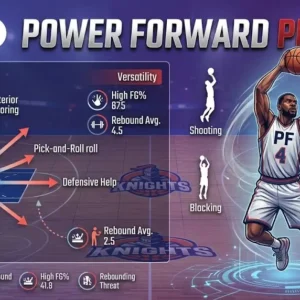
A power forward (PF) is one of the five main positions in basketball, usually called the “4” or four. Power forwards are part of the team’s frontcourt, along with the centre, and usually play closer to the basket than guards and small forwards.
Think of the power forward as the team’s strong inside player. They rebound, defend near the basket, score in the post, set screens, and help protect the rim. In modern basketball, many power forwards can also shoot from outside, making them even more versatile.
Main Responsibilities of a Power Forward
A power forward does more than just stay near the basket. They must rebound, score inside, defend bigger players, set screens, and sometimes shoot from distance.
Responsibility | What It Means in Simple Words |
Rebound | Grab missed shots on both offence and defence. |
Score near the basket | Finish layups, dunks, and close-range shots. |
Use strength and footwork to score with their back to the basket. | |
Set screens | Block a defender to free up a teammate for a shot or drive. |
Defend the paint | Stop opponents from driving and scoring near the basket. |
Box out | Use the body to keep opponents away from the rebound. |
Shoot mid-range or threes | Modern power forwards often stretch the defence by shooting outside. |
After a rebound, pass ahead to a guard or run the floor. |
What a Power Forward Does on Offence
1. Score Near the Basket
Power forwards usually score from close range. They can score through layups, dunks, putbacks, and short shots around the basket.
For a beginner, remember this: the power forward is often one of the team’s main rebounders and inside scorers. They use strength and positioning to get good shots near the rim.
2. Play in the Post
The post is the area near the basket, usually around the low block. A power forward may receive the ball there with their back to the basket, then use a move to score.
Common post moves include:
- Drop step: Turn toward the basket and finish.
- Hook shot: Shoot over a defender using one hand.
- Up-and-under: Fake one way, then step the other way for a layup.
- Jump hook: A higher, more difficult version of the hook shot.
Good post play requires strength, balance, patience, and footwork.
3. Set Screens
Power forwards often set screens for guards and wings. A screen is when the power forward stands in a defender’s path to help a teammate get open.
After setting a screen, the power forward can:
- Roll to the basket for a pass and easy score.
- Pop out for a mid-range or three-point shot.
- Re-screen if the first screen does not create an advantage.
This is called pick-and-roll or pick-and-pop basketball. It is one of the most common offensive actions in the modern game.
4. Shoot From Outside
Modern power forwards are often expected to shoot from mid-range or three-point range. A power forward who can shoot from outside is often called a stretch four because they “stretch” the defence away from the basket.
If the power forward can shoot, the opposing big defender must come outside to guard them. This creates more space near the basket for teammates to drive and score.
5. Rebound on Offence
Power forwards are major rebounders. When a teammate misses a shot, the power forward should crash the boards and try to get the ball back.
An offensive rebound can lead to:
- A second-chance shot.
- A putback basket.
- A foul on the defender.
- A kick-out pass to an open shooter.
What a Power Forward Does on Defence
1. Protect the Paint
A power forward must help protect the area near the basket. This means stopping easy drives, contesting shots, and making attackers work hard for every point.
They do not always need to block every shot. Good positioning can force the opponent to pass, take a difficult shot, or move away from the basket.
2. Box Out for Rebounds
Boxing out is one of the most important defensive skills for a power forward. After a shot goes up, the PF should find the nearest opponent and use their body to keep them away from the basket.
A good box-out helps the team secure the rebound and end the opponent’s possession.
3. Defend Bigger Players
Power forwards often defend the opposing team’s power forward or a bigger wing player. They must use strength to hold their position and prevent easy scores near the basket.
They also need quick feet to defend players who can shoot from outside.
4. Help Defend the Rim
When a guard or small forward gets beaten by a drive, the power forward may need to step in and help. This is called help defence.
The goal is to slow the attacker or force a difficult pass. After helping, the power forward must recover to their own player so they do not leave an opponent open.
5. Block or Alter Shots
Many power forwards are good shot-blockers because of their height and strength. Even if they cannot block the shot, they can alter it by making the shooter change the angle or rush the attempt.
A good block can stop a basket and sometimes start a fast break.
Skills Every Power Forward Needs
Skill | Why It Matters |
Rebounding | Power forwards must secure missed shots and create extra possessions. |
Post scoring | Helps them score near the basket against defenders. |
Finishing | They must convert layups, dunks, and close-range chances. |
Screening | Helps teammates get open shots and driving lanes. |
Mid-range and three-point shooting | Makes the power forward harder to guard. |
Defence | Helps protect the rim and stop opposing big men. |
Passing | Helps start fast breaks and find open teammates. |
Strength and conditioning | Needed for physical play, rebounding, and defending big players. |
Power Forward vs Centre
The power forward and centre are both “big men,” but they usually have slightly different roles.
Feature | Power Forward (PF) | Centre (C) |
Position number | 4 | 5 |
Typical role | Versatile big man | Main interior defender and rebounder |
Location | Near the basket, but can step outside | Usually closest to the basket |
Shooting | Often shoots mid-range or threes | Usually focuses more on inside scoring |
Ball handling | Often better ball handling | Usually less involved in handling |
Defence | Guards power forwards and helps inside | Usually guards the opposing centre and protects the rim |
Power forwards are generally more mobile and better at longer-range shooting than centres, hile centres are usually the tallest players and focus more on rim protection.
Famous Power Forwards
Tim Duncan
Tim Duncan is widely considered one of the greatest power forwards in NBA history. He played for the San Antonio Spurs and was known for his fundamentals, rebounding, defence, scoring, and calm leadership.
Duncan won five NBA championships and was one of the best defensive players ever, with 15 All-Defensive Team selections.
Karl Malone
Karl Malone is another legendary power forward. He was known for his strength, durability, scoring, and ability to finish around the basket.
Malone scored 36,928 career points, one of the highest totals in NBA history, and won two NBA MVP awards.
Dirk Nowitzki
Dirk Nowitzki changed the power forward position with his shooting ability. He was one of the first great “stretch fours,” using his height and shooting touch to score from long range.
Dirk won an NBA MVP award and a Finals MVP award with the Dallas Mavericks.
Other Famous Power Forwards
- Kevin Garnett – Known for defence, rebounding, intensity, and versatility.
- Giannis Antetokounmpo – A modern forward who uses size, speed, and strength to attack the rim.
- Pau Gasol – Known for passing, footwork, scoring, and championship success.
- Charles Barkley – A smaller but extremely strong rebounder and scorer.
- Anthony Davis – A modern big man known for shot-blocking, rebounding, and scoring.
Power Forward vs Small Forward
The small forward and power forward are both forwards, but they usually play in different areas of the court.
Feature | Small Forward (SF) | Power Forward (PF) |
Position number | 3 | 4 |
Main role | Versatile wing scorer and defender | Inside scorer, rebounder, and rim protector |
Typical location | Wing, outside the three-point line | Near the basket, post, and paint |
Main strength | Speed, shooting, versatility | Strength, rebounding, interior defence |
Rebounding | Secondary rebounder | Primary rebounder |
Defence | Guards wings and perimeter players | Guards’ bigger forwards and protects the paint |
Small forwards usually play more on the outside, while power forwards play closer to the basket.



Picking a basketball shoe in 2026 means wading through more signature lines, cushioning tech, and marketing buzzwords than ever. Nike, Adidas, Under …
Find the best women's basketball shoes for superior performance and comfort. Our expert picks offer exceptional support, traction, durability the court.
Find the fundamental variables, estimating tips, padding advancements, and support methodologies for finding the best men's basketball shoes.


